
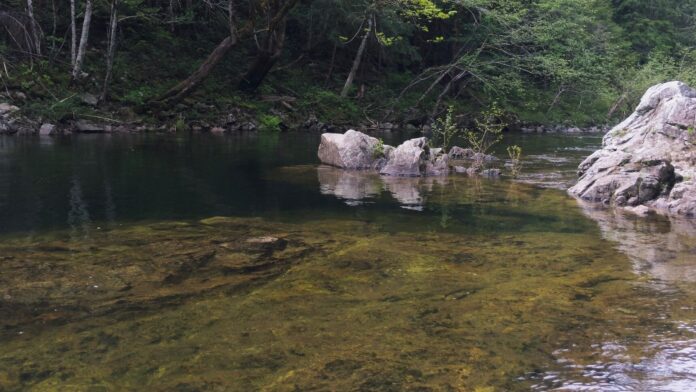

Low water in the Koksilah River, caused by drought conditions, has prompted changes to irrigation schedules at nearby farms.
Tom Rutherford of the Cowichan Watershed Board says farmers are cutting back irrigation to leave more water in the river.
He says they have “divided into two teams, and so one team irrigates and then they shut down and the other team irrigates,” which he says is “really unique” in British Columbia.
“I think it’s another example of everyone trying to pull together on a rope, right, to make sure we are doing the right thing”
The Cowichan Watershed Board says such actions have been needed almost annually in recent years to reduce impacts to critical fish habitat.
The board says in-stream monitoring shows such changes to irrigation provide a significant benefit to aquatic life in the river and it encourages everyone to try to match that effort at home.
In a social media post, the CWB says it wants to “acknowledge local food producers for taking this step once again and encourage everyone else to try to match that effort at home. Please aim for 50% less water demand. This can often be achieved by simply fixing leaks or using a timer.”
Other suggestions from the board to reduce water use include:
– let all lawns go ‘golden’ in the summer. Give your lawnmower a rest and you too!
– install efficient irrigation equipment, like micro-drip tape, timers, or soil sensors. These all help you water only when and where needed, and they save you time.
– mulch! Protect your soil from evaporation in the hot weather, and keep weeds in check while you’re at it.
– leave any power-washing until the fall. Power-nap instead.
Rutherford says when it comes to aquatic habitat, the Koksilah has a small advantage over the Cowichan River because temperatures are generally cooler as there is more groundwater influence.
He says the flow of water in the Koksilah River, as a percentage of mean annual discharge, is lower than the Cowichan River and is very low at this time.
Rutherford says the current dry conditions in the Cowichan Valley, and Vancouver Island in general, are “what climate change looks like for us here on the east side of the Island,” less water in the rivers in the summer, no rain in the summer, and less snow in the water.
He says for fish the low water levels are compounded by the fact that not only is there not as much water, but it’s much warmer.
“Those two things, whether you’re in the Cowichan, or the Koksilah, the Chemainus, or the Tsolum, they’re not good news because our salmon and our trout, and actually the whole aquatic ecosystems have evolved over millennia to have more, cooler water in the rivers than we are having now.”
Rutherford says we are lucky in the Cowichan Valley because there are volunteers and professionals who are very concerned about the local fish habitat and are working together to protect it.