
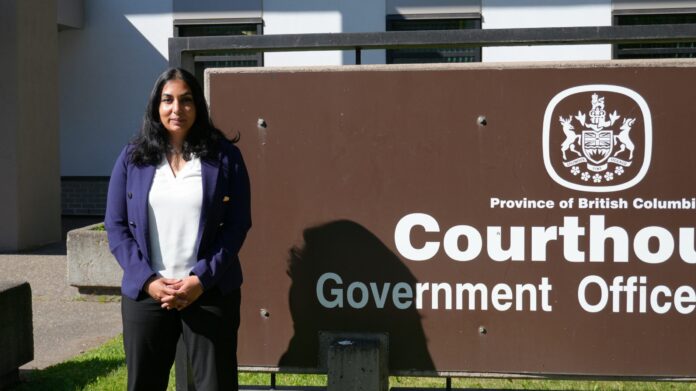

The province is marking five years since launching virtual bail hearings in the court system.
The program’s main goal was to help improve efficiency by modernizing court processes.
“It’s something that really was a pilot project here up north,” said Attorney General Niki Sharma in Smithers.
“It was so successful that we expanded it across the province.”
Since its inception, 112 virtual bail units have been installed at RCMP and municipal police detachments across B.C., according to the province.
The province has also created six dedicated virtual bail courtrooms and six hybrid courtrooms.
The province said that before the program was introduced, people arrested in areas far from a courthouse had to be transported in custody to attend hearings.
That was a challenge in rural and remote communities, particularly when road conditions were poor.
“Virtual bail has been a really good addition up north that was so successful in terms of how it made trials go faster and helped judges or court processes not have to travel,” said Sharma.
“If there’s bad weather, you can still keep things going, and it’s better for public safety because people expect their court systems on time.”
Sharma said judges have noted the program created opportunities to prevent trials from stalling.
While primarily used by the Provincial Court system, Sharma said the tools are also available for the Supreme Court of British Columbia.
Virtual bail hearings also work hand in hand with other programs, including the Chronic Property Offender Intervention Initiative.
Because bail hearings determine if an accused person remains behind bars, Sharma said they take precedence over other court matters.
“They used to just punt hearings because every time a bail hearing came up, everything would be cleared and you imagine in a busy court room what that does to everything else,” she said.
The province also extended the hours during which bail hearings are held, which Sharma said has kept regular hearing disruptions down.
She added the province continues to look for ways to modernize the court system.