
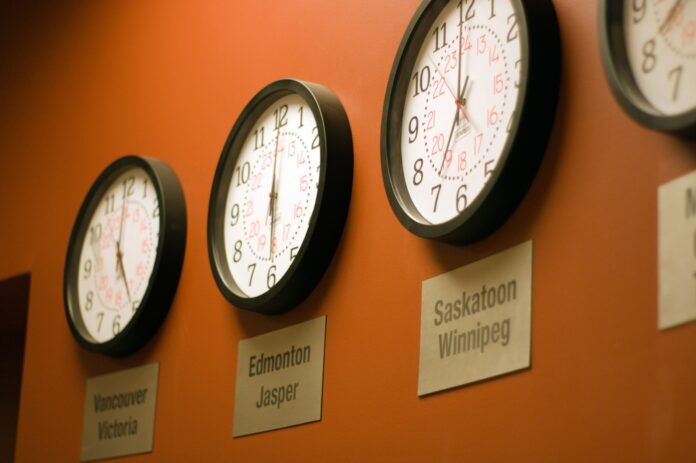

Most of British Columbia stayed on daylight saving time Sunday, completing its move to permanent daylight time, but experts warn the change may create some confusion for businesses and travellers.
B.C. announced earlier this year it would do away with the tradition of “falling back” in November and “springing forward” in March.
Several other Canadian jurisdictions also don’t change their clocks, including Yukon, Northwest Territories, Saskatchewan, Alberta and Manitoba.
However, much of Eastern Canada still observes the twice-yearly time change, along with most U.S. states.
Barry Prentice, professor of supply chain management at the University of Manitoba’s Asper School of Business, said it could take some time for companies that do business across borders to adjust to B.C.’s new time zone, known as Pacific Time (PCT).
“This is a teething phase,” said Prentice.
He said some calendars and phones have had trouble automatically adjusting for daylight saving time, which could affect meeting times and scheduling for businesses.
“The people in the U.S. may not be quite as aware of our change here as we are. So there may be a lot of missed appointments and calls that don’t get completed because of that,” he said.
John Gradek, faculty lecturer and area co-ordinator of Aviation Management and Supply Chain Management at McGill University’s School of Continuing Studies, said airlines have accounted for the time changes.
He said travellers can generally rely on airlines’ schedules, but should ensure their own clocks are properly synchronized and double-check their itineraries to avoid disruptions.
He said other systems that automatically adjust for different time zones might be slower to update, like car rental and bus companies or cruise ship companies.
“I would be very wary of that automatic process for the first few months until everybody gets their bugs out,” said Gradek.