
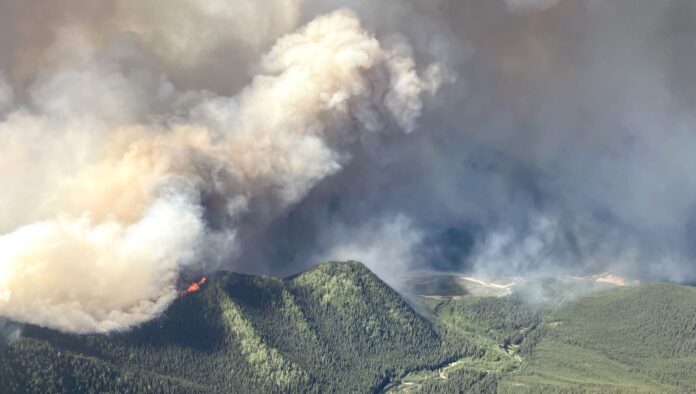

Forests Minister Ravi Parmar says British Columbia is hoping for the best this wildfire season but is preparing for the worst.
“My message to all British Columbians is that … we’re ready,” Parmar said Monday during an emergency preparedness briefing. “We’ve got 1,300 wildland firefighters ready to go to be able to support and protect communities.”
Parmar urged B.C. residents to stay informed and prepared, particularly with forecasts calling for warm and dry conditions across much of the province.
He said more than 100 B.C. firefighters are currently assisting with wildfires in Manitoba, Saskatchewan and Alberta, but most will return as the province’s wildfire season intensifies.
Neil McGoughlin with the BC Wildfire Service said forecasters expect warmer-than-normal temperatures this summer, highlighting several “areas of concern” due to ongoing drought, low snowpack, and limited spring precipitation. Those regions include the southwest Interior, the Chilcotin, and the far northwest.
However, McGoughlin said the primary area of concern this season is the northeast’s Prince George Fire Centre region. The region already has three wildfires of note, including the out-of-control Kiskatinaw River wildfire, which has prompted evacuation orders over a large area near the Alberta border.
The BC Wildfire Service said Monday the Kiskatinaw River wildfire has grown to more than 216 square kilometres and continued spreading eastward over the weekend. Crews remain in the evacuated community of Kelly Lake to defend homes and critical infrastructure.
Keven Dunbar, executive director of provincial and regional operations with the Ministry of Emergency Management and Climate Readiness, said as many as seven structures have burned in Kelly Lake, but a complete assessment has not yet been done due to ongoing wildfire risks.
Evacuations have also been ordered due to the Summit Lake wildfire, covering approximately 190 square kilometres, and the Pocket Knife Creek wildfire, which is about 610 square kilometres.
Rob Schweitzer, assistant deputy minister with the Ministry of Forests, said the province is actively preparing for increased wildfire activity in the northeast. He said most wildfire personnel in B.C. are now in the region, setting up sprinkler systems and assessing homes to improve protection efforts.
B.C. had its most devastating wildfire season on record in 2023, with more than 2.8 million hectares burned. Last year’s season was less severe but still above average, burning more than one million hectares.
Emergency Management Minister Kelly Greene emphasized preparedness, urging residents to have emergency plans ready.
“Preparedness is very much a team effort,” said Greene. “That means getting your grab-and-go bag ready, making sure your insurance is in order, that you have the things that you need as a household to respond as necessary.”
Greene recommended registering in advance for the BC Services Card app to expedite receiving emergency support if evacuations are necessary.
The province also announced Monday it is expanding a camera network to improve wildfire detection and monitoring. In a press release, the government said it is investing $200,000 to expand cameras that “detect smoke from wildfires and provide real-time data to support evacuation planning, resource deployment and wildfire behaviour predictions.”
The technology was successfully tested in five locations last year in partnership with the University of British Columbia’s Okanagan campus.